I have a new paper out in PNAS Nexus that represents that rare scholarly win, the negative result. It's "Gender and culture shape prosociality more than heat stress in a five-country experiment" with several USF faculty colleagues, several additional coauthors around the world, and no fewer than *nine* former MS graduate students from USF. In it, we show that whatever is driving the very well-documented link between contemporaneous heat and violence, it's not changes in people's fundamental social preferences themselves. Put differently, while heat does make people more aggravated, tried, and unhappy (effects which we replicate), higher temperatures don't change measurable aspects of people's personalities, at least not as measured by a standard battery of experimental tests.
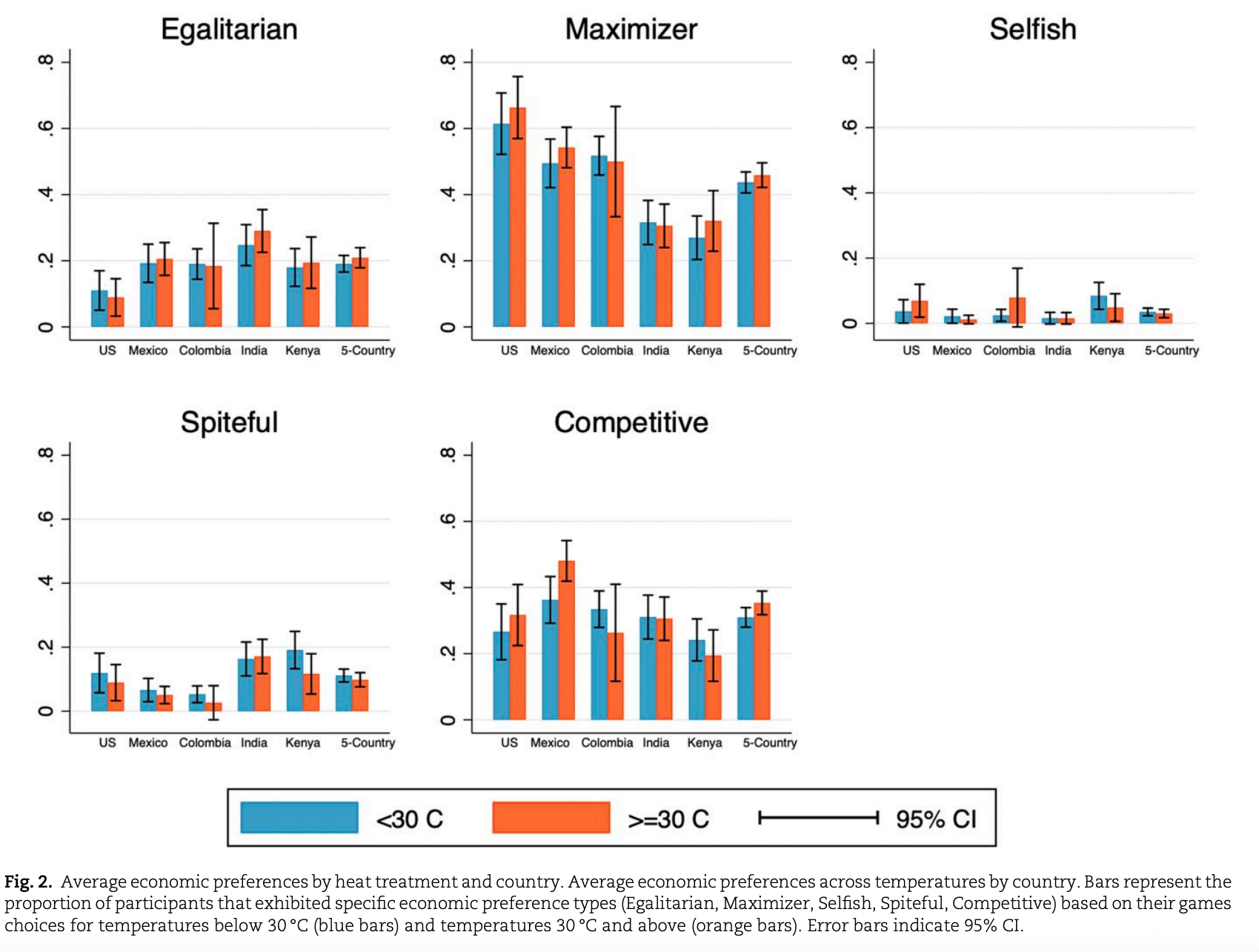
I think there's a few things worth noting about this paper. The first is that it was a massive team effort motivated by the science literature and coordinated by USF's long-time in house experimentalist Alessandra Cassar. The setup was designed to address the relatively scant prior work by expanding the sample to five countries and really trying to get some material variation in both dry and wet bulb temperature. To do this we coupled natural intra-site variation in temperature from week to week with a randomly assigned additional heating treatment, by way of a heater that was left on in the experimental room. We took advantage of the unusual nature of the USF MS research program's field research mandate to run the same experiment, with the same widely-used best-practices protocol, in five different country sites. In short, if there were effects of high temperatures on social preferences we were pretty well set up to find them.
That leads me to point two, which is that I think this paper's meaningful and robust null result is a nice example of designing research with care. Because we were thorough in the original design, and pre-registered the experiment, we had a tidy path forward no matter what we found. Obviously not all null results can be framed as successfully, but that was part of the choice of our collective efforts. Here we had something with a lot of persistent confusion and attention, so putting a flag in the ground that says "future research should more closely examine alternative channels" is valuable. Whatever it is that causes hot days to lead to more fights, murders, rapes, and suicides, it's not an increase in, say, spitefulness, or competitive drive, per se.
The point I'll end on is that getting the document honed and crafted into its current form took a ton of time and a lot of very material human labor, even with such a widely-ranging and broadly talented team. It's great watching certain aspects of these tasks get cheaply automated with the new AI agent systems, but many others (most of the ones facing other humans?) do not seem to be so reducible. I'll have more to say on this one soon, but definitely another positive signal for the "ai as demand-inducing complement to junior researchers" view.